
Statute of Westminster 1931
Act granting Dominions legislative independence from the UK.

The Council of Law Reporting · Public domain
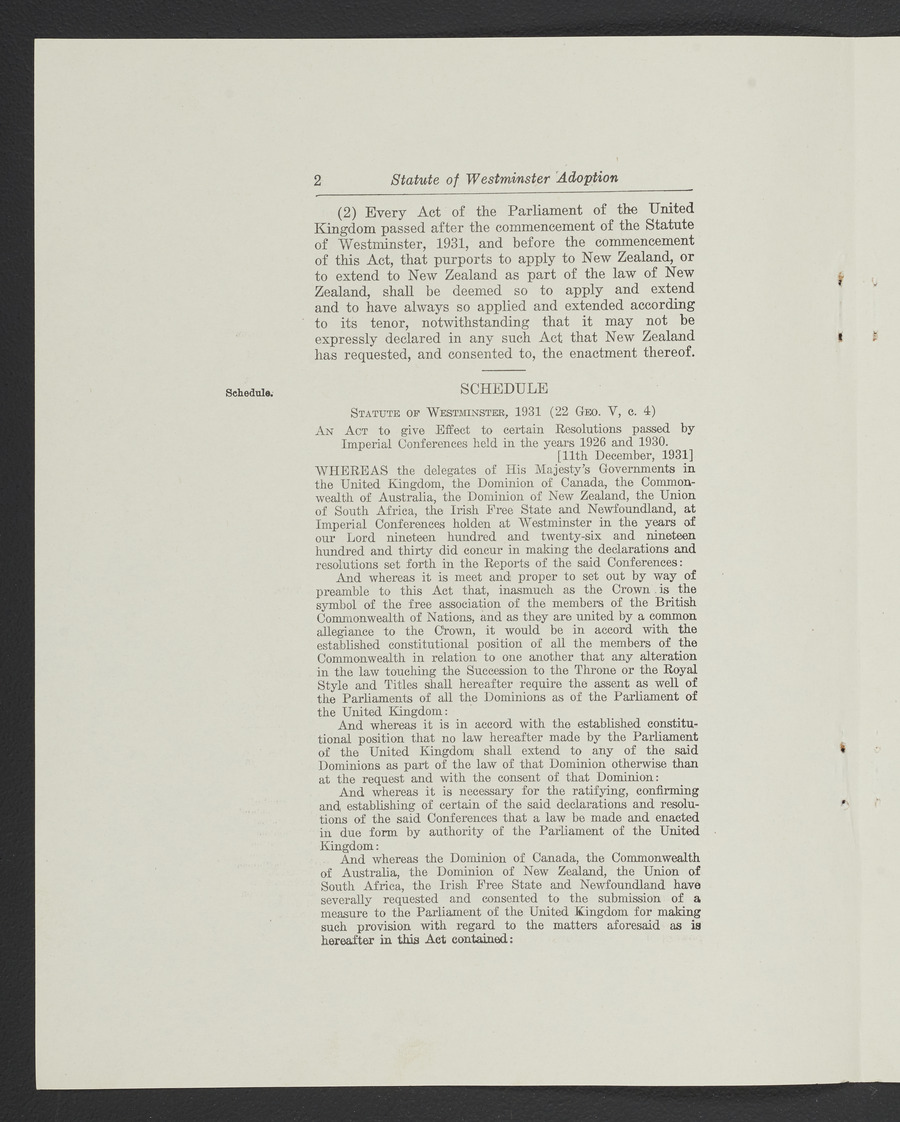
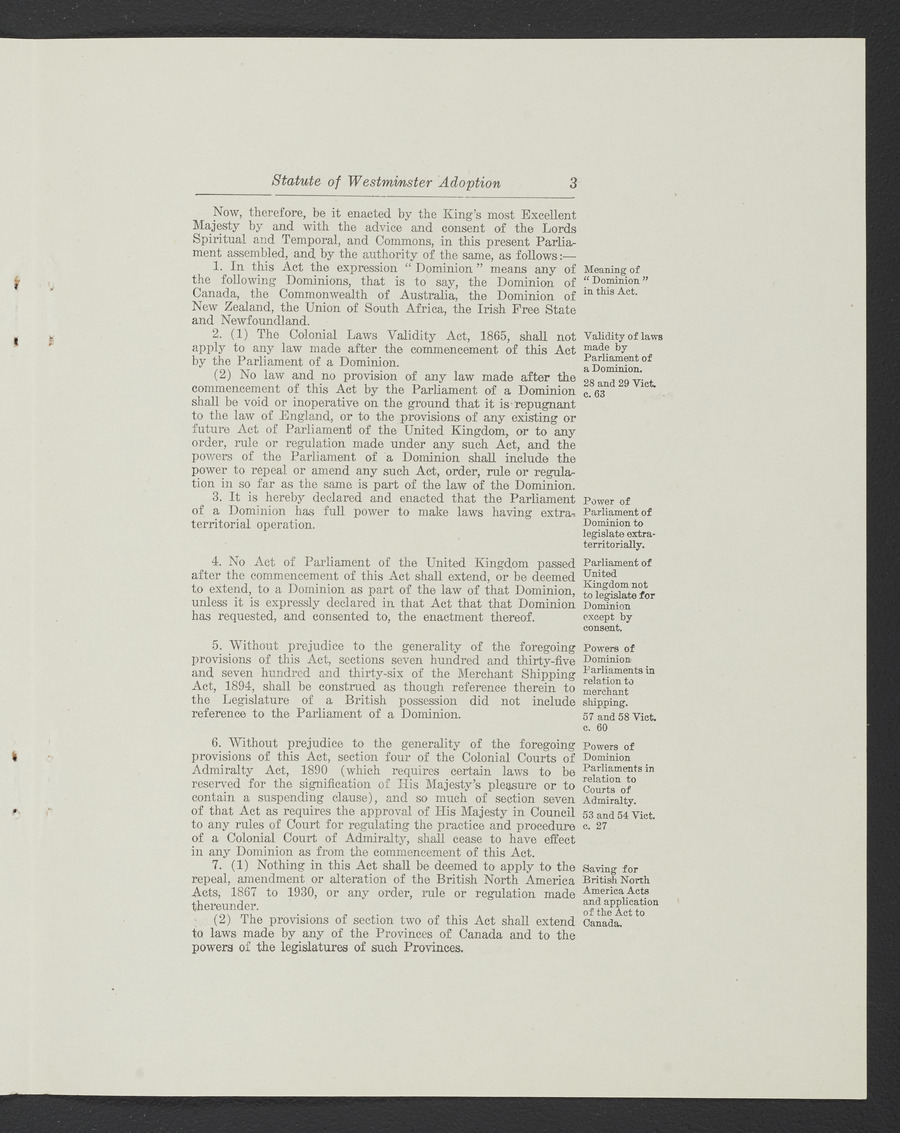
The Statute of Westminster 1931 was a law passed by the UK Parliament on 11 December 1931. It gave the self-governing Dominions of the British Commonwealth much more independence from Britain. The law increased their sovereignty and required them to agree with each other before changing royal titles or the line of succession. It took effect either right away or after each Dominion ratified it. This act put into law the ideas of equality and shared loyalty to the Crown that had been stated in the 1926 Balfour Declaration. By removing almost all of the British Parliament’s power to make laws for the Dominions, it was a key step toward them becoming fully separate, independent, and sovereign nations.
- enacted
- 11 December 1931
- jurisdiction
- United Kingdom
- type
- Act of Parliament
- citation
- 22 & 23 Geo. 5. c. 4
- purpose
- Increased autonomy of Dominions of the British Commonwealth
- key_effect
- Removed British parliament's authority to legislate for Dominions without their consent
Lore & Background
The Statute of Westminster gave effect to political resolutions passed by the Imperial Conferences of 1926 and 1930, particularly the Balfour Declaration of 1926. Its main effect was the removal of the ability of the British parliament to legislate for the Dominions, requiring the repeal of the Colonial Laws Validity Act 1865 in its application to the Dominions. King George V expressed a desire that laws of royal succession be exempt, but this was determined contrary to the principles of equality. Canada and the Irish Free State pushed for the ability to amend succession laws themselves, leading to section 2(2) allowing a Dominion to amend or repeal laws of paramount force insofar as they are part of that Dominion's law.
The statute provided in section 4 that no UK Act passed after its commencement would extend to a Dominion unless expressly declared that the Dominion had requested and consented. Section 2(1) stated that no law of a Dominion would be void for repugnancy to English law. The whole statute applied immediately to Canada, the Irish Free State, and the Union of South Africa. Section 10 provided that sections 2 to 6 would apply to Australia, New Zealand, and Newfoundland only after their respective parliaments legislated to adopt them.
Reader's Guide
The Statute of Westminster 1931 was a landmark in the evolution of the British Empire into the Commonwealth of Nations. By removing the British parliament's authority to legislate for the Dominions without their consent, it granted them de facto sovereignty and legislative independence. This act codified the Balfour Declaration's principle that Dominions were equal in status to the United Kingdom and to each other. Its immediate application to Canada, the Irish Free State, and South Africa, and later adoption by Australia, New Zealand, and Newfoundland, allowed these states to develop as fully independent nations. The statute also bound the Dominions to seek each other's approval for changes to monarchical titles and succession, preserving a common Crown. Its modified versions remain domestic law in Australia and Canada, while it is no longer in effect in New Zealand and has been implicitly repealed in former Dominions that are no longer Commonwealth realms. The statute's legacy is the foundation of the modern Commonwealth, where member states are sovereign and equal.
Did You Know?
- The statute was passed on 11 December 1931.
- It removed nearly all of the British parliament's authority to legislate for the Dominions.
- Canada and the Irish Free State pushed for the ability to amend succession laws themselves.
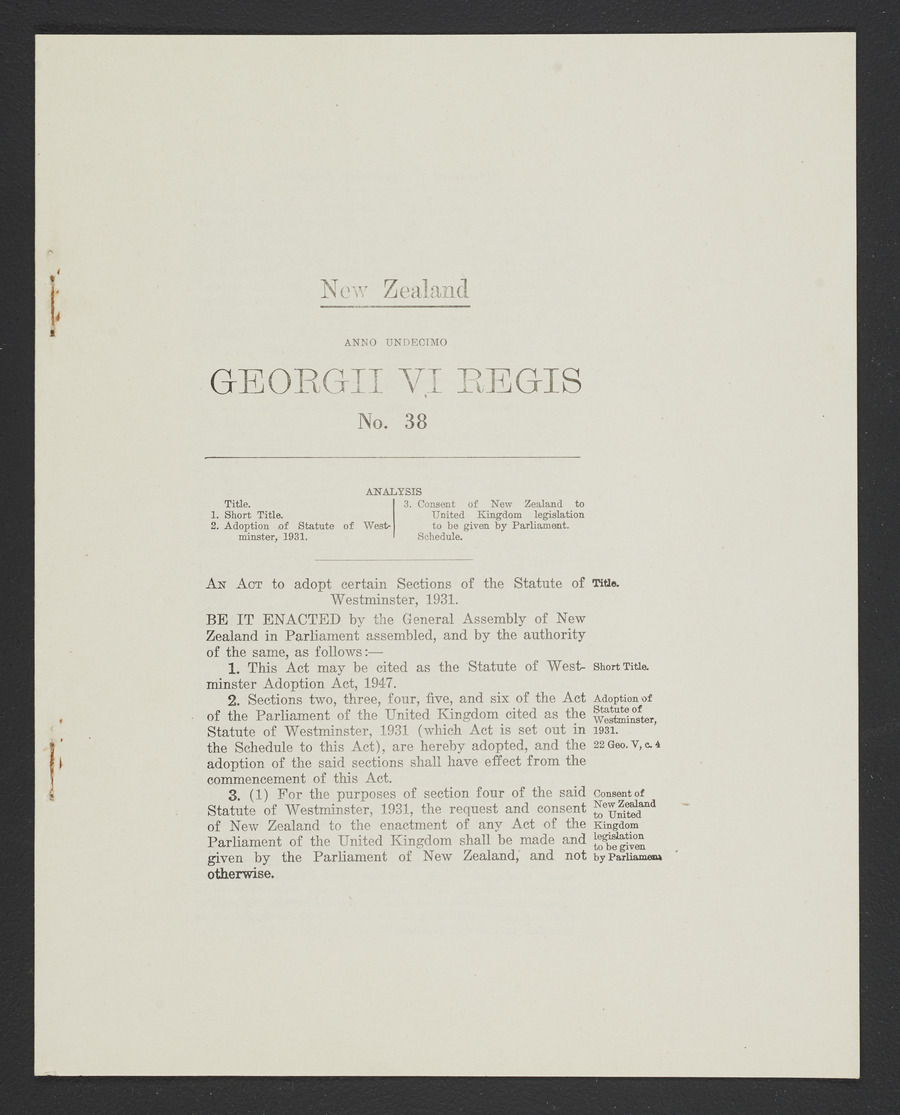
- Australia adopted sections 2 to 6 of the statute with the Statute of Westminster Adoption Act 1942, backdated to 3 September 1939.
The League of Nations: Promise and Collapse
The League of Nations, established in 1919, was designed as the central mechanism for maintaining peace and settling international disputes. However, its effectiveness was severely undermined from the outset by the absence of several major powers: the United States, Germany, the Soviet Union, and eventually Japan all chose not to participate or withdrew. When major nations refused to comply with adverse decisions, the League had no real mechanism to enforce them. The Japanese invasion of Manchuria exposed this weakness dramatically—Japan was censured but simply abandoned the organization. The Abyssinian Crisis of 1934 to 1936 followed a similar pattern, as Italy invaded Ethiopia and the League's attempted economic sanctions proved futile. British and French reluctance to alienate Italy, fearing they would lose a counterweight against Hitler's Germany, further exposed their vulnerabilities. The limited response pushed Mussolini toward alliance with Berlin. The League also played no role in the Spanish Civil War and failed to resolve smaller conflicts like the Rif War between Spain and Moroccan separatists. Historians broadly agree the institution proved ineffective in handling major disputes.
Naval Disarmament and the Washington-London Framework
In the absence of major warfare during the 1920s, with only peripheral conflicts like the Russian Civil War, the Polish-Soviet War, and the Greco-Turkish War winding down by 1922, the international community turned its attention to preventing future military confrontations. The Washington Naval Conference, convened by President Warren G. Harding and chaired by Secretary of State Charles Evans Hughes from November 1921 to February 1922, brought together nine nations to address Pacific and East Asian tensions. The Soviet Union was notably excluded. The conference produced three landmark treaties—the Four-Power, Five-Power (Washington Naval), and Nine-Power Treaties—alongside smaller agreements that established naval limitations lasting roughly a decade. Britain subsequently took the diplomatic lead, and the London Naval Treaty of 1930 extended these warship restrictions among the major powers. These arrangements helped preserve peace throughout the 1920s, yet they were never renewed as the global situation deteriorated sharply from 1931 onward.
The Spirit of Locarno and Its Shattering
The seven treaties negotiated at Locarno in 1925 represented a watershed moment in European diplomacy. By significantly strengthening Germany's legitimacy on the international stage, these agreements paved the way for Germany's admission to the League of Nations in 1926 with a permanent council seat, and for the withdrawal of Allied forces from the Rhineland. The political atmosphere in western Europe between 1924 and 1930 improved dramatically, fostering what contemporaries called the "spirit of Locarno"—a belief that conciliation, rather than enforcement, could sustain lasting peace. British Prime Minister Ramsay MacDonald articulated this vision, arguing that moral guarantees flowing from conciliation, arbitration, and impartial judicial judgment would prove more effective than military pacts. Yet historian Sally Marks cautioned that for many, peace remained a desperate hope rather than an achieved reality, and that a few recognized the fragile foundations beneath this optimism. The illusion was shattered on 7 March 1936, when Nazi Germany sent troops into the demilitarized Rhineland, formally repudiating the Locarno framework.
The Cascade of Crises Toward a Second War
The interwar period was shaped by a cascade of diplomatic and economic challenges that progressively eroded the post-war order. Resolving wartime issues such as German reparations and national boundaries consumed early efforts, while American involvement in European finances and disarmament projects added another layer of complexity. The relationships between newly formed states and established powers created ongoing tensions, and the Soviet Union's isolation from the capitalist world bred persistent mutual distrust. The Great Depression, beginning in 1929, triggered a collapse in world trade and accelerated the growth of economic autarky. Democratic regimes fell one after another, creating space for fascist diplomacy. Fascist Italy and Nazi Germany pursued increasingly aggressive foreign policies, while Japan's expansion toward China threatened the Pacific order. The Kellogg-Briand Pact of 1928, which most nations signed to renounce war as a tool of policy, offered symbolic hope but lacked enforcement mechanisms. By the late 1930s, Germany's expansionist moves toward the Rhineland, Austria, and Czechoslovakia, combined with desperate rearmament efforts, signaled that another world war was drawing near.
Gallery

Frequently Asked Questions
What is the Statute of Westminster 1931?
It is an Act of Parliament enacted by the British legislature on 11 December 1931 (cited as 22 & 23 Geo. 5. c. 4). Its central aim was to grant the self-governing Dominions of the British Commonwealth substantially greater legislative independence from London.
What did the Statute of Westminster 1931 actually change in practice?
It stripped the UK Parliament of its remaining legal authority to legislate for the Dominions without their explicit consent. It also required that any alteration to the royal title or the order of succession needed the agreement of every Dominion before it could take effect.
Why is the Statute of Westminster 1931 considered a landmark in international law?
It transformed the legal relationship between Britain and its Dominions from one of hierarchical authority into one of equal sovereign partners sharing loyalty to the Crown. In doing so, it codified the principles of self-governance and mutual respect that had been articulated earlier in the 1926 Balfour Declaration.
How did the Statute of Westminster 1931 come into force?
Rather than applying uniformly overnight, the statute became operational either immediately or once each individual Dominion formally ratified it. This staggered adoption process acknowledged that each Dominion was a distinct political entity with its own legislative timetable.
Who passed the Statute of Westminster 1931 and under what jurisdiction?
It was enacted by the Parliament of the United Kingdom, sitting in its traditional legislative capacity. The act emerged from inter-Dominion negotiations and reflected the collective desire of the Commonwealth's self-governing territories to formalize their de facto independence into binding law.
More in International Law & Diplomacy 1-24
Spotted an error? Know more?
This is a living reference — every entry is fact-audited, and reader corrections feed straight into our audit queue. Suggest an edit · See this site's audit record