
Secession
Secession is the unilateral withdrawal of territory to form a new state.

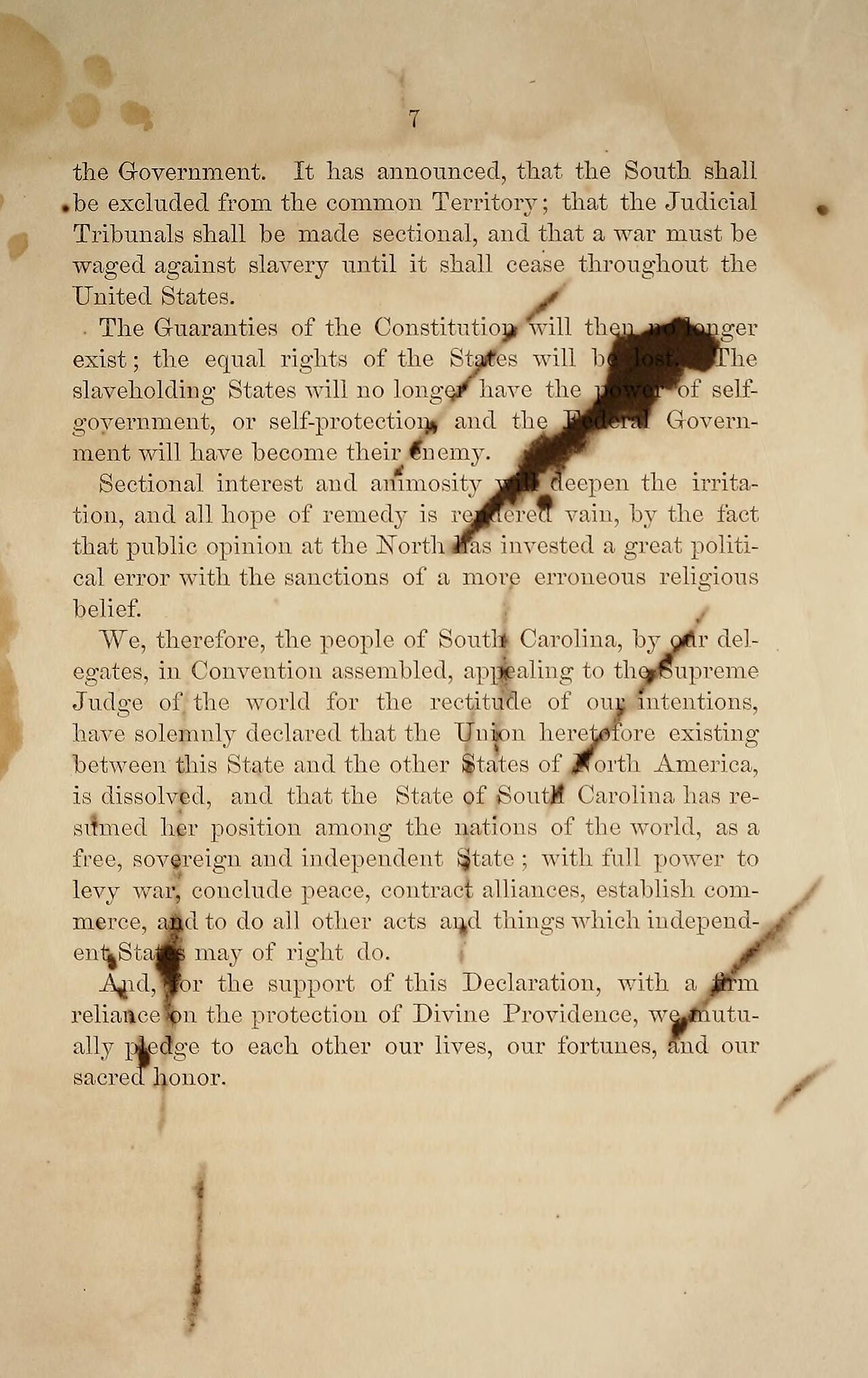
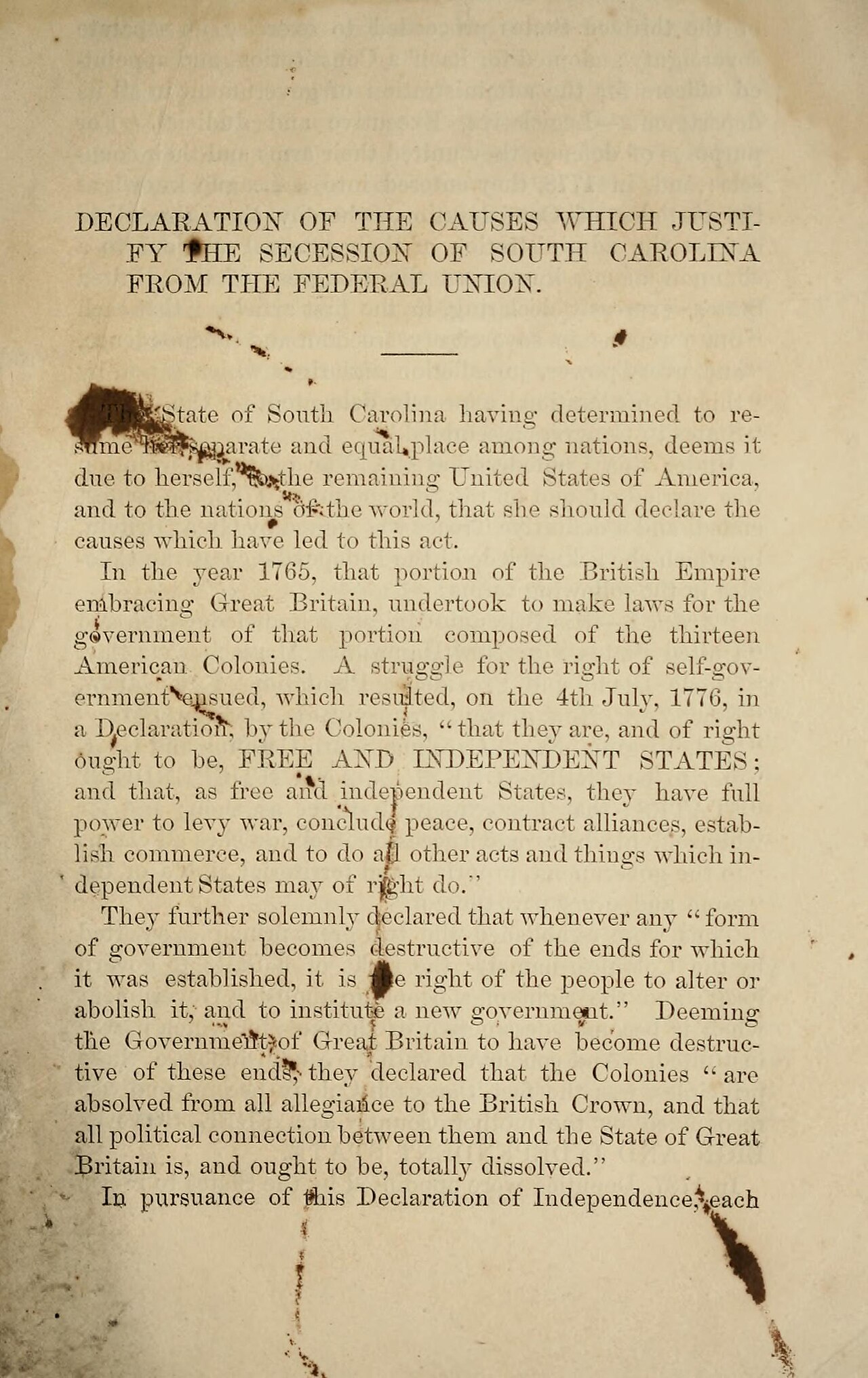
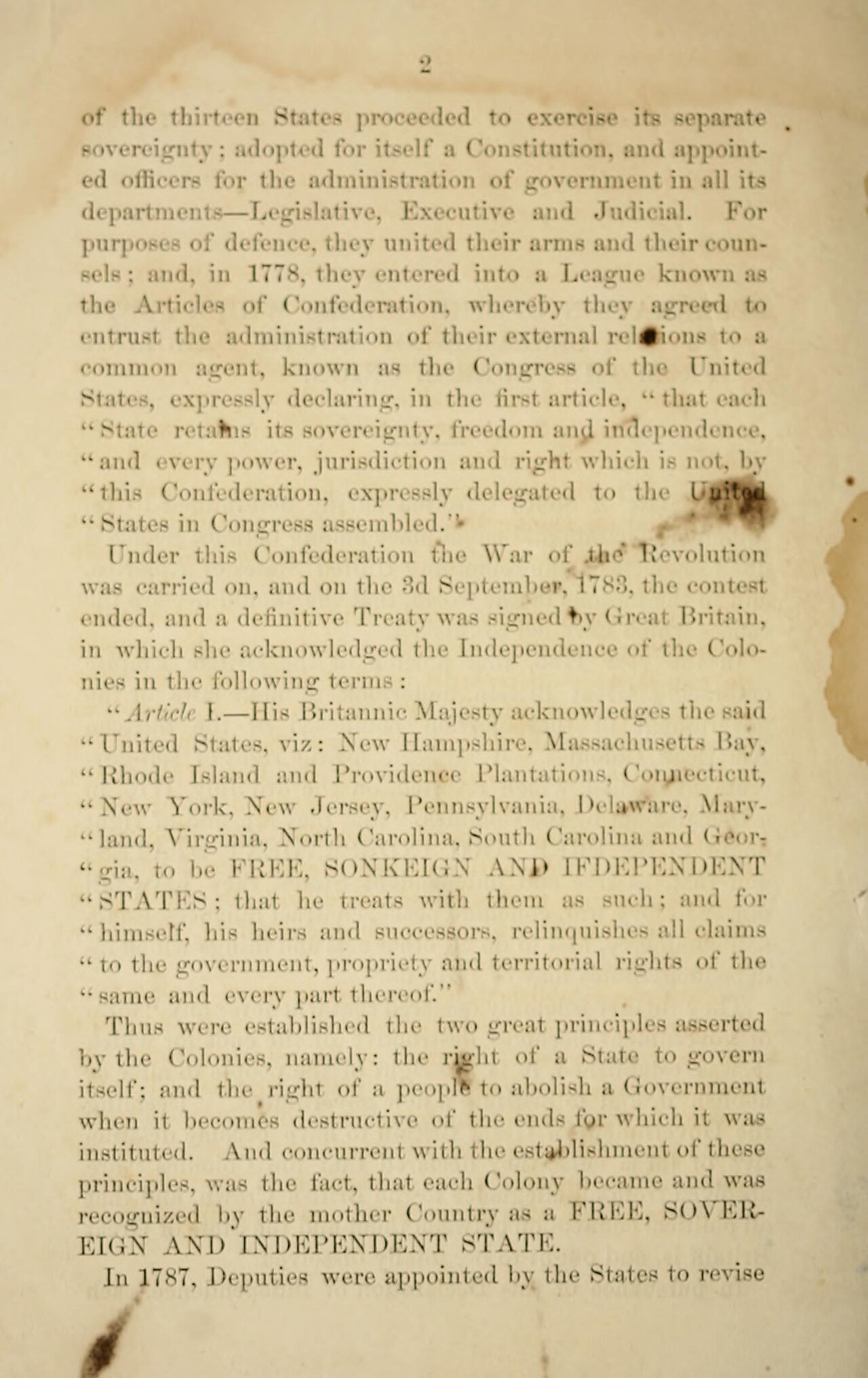
South Carolina. Convention (1860-1862) · Public domain
Secession is the unilateral withdrawal of an integral part of a state's territory, generally aiming to establish a separate political entity, typically a sovereign state, though it may instead seek accession to another existing state. It often begins with an act such as a declaration of independence and may be pursued peacefully or through armed conflict. Scholars distinguish secession from related concepts such as separatism, and theories of secession differ over its causes, moral justification, and legal status.
- field
- Political science, international law, philosophy
- known_for
- Unilateral withdrawal of territory to form a new state; debated right to secede under certain conditions
- related_concepts
- Separatism, self-determination, decolonization, breakup of federations
- key_theorists
- Allen Buchanan, Ahsan Butt, Bridget L. Coggins, David Gordon
Lore & Background
Secession has occurred throughout history through decolonization, the breakup of federations and multinational states, and regional independence movements. Historical and contemporary secessionist movements have sought independence or greater autonomy in many parts of the world. Threats of secession may be used to obtain greater autonomy or other political concessions short of independence. According to the 2017 book Secession and Security, by political scientist Ahsan Butt, states respond violently to secessionist movements if the potential state poses a greater threat than the would-be secessionist movement. States perceive a future war with a potential new state as likely if the ethnic group driving the secessionist struggle has deep identity division with the central state, and if the regional neighborhood is violent and unstable.
Reader's Guide
The political philosophy of the rights and moral justification for secession began to develop as recently as the 1980s. American philosopher Allen Buchanan offered the first systematic account of the subject in the 1990s and contributed to the normative classification of the literature on secession. In his 1991 book Secession: The Morality of Political Divorce From Fort Sumter to Lithuania and Quebec, Buchanan outlined limited rights to secession under certain circumstances, mostly related to oppression by people of other ethnic or racial groups, and especially those previously conquered by other people. In his collection of essays from secession scholars, Secession, State, and Liberty, professor David Gordon challenges Buchanan, making a case that the moral status of the seceding state is unrelated to the issue of secession itself. Some theories of secession emphasize a general right of secession for any reason ('Choice Theory') while others emphasize that secession should be considered only to rectify grave injustices ('Just Cause Theory'). International law generally neither recognizes a broad right of unilateral secession nor absolutely prohibits it, while the constitutional law of individual states varies considerably.
Did You Know?
- Secession often begins with an act such as a declaration of independence.
- Scholars distinguish secession from related concepts such as separatism.
- International law generally neither recognizes a broad right of unilateral secession nor absolutely prohibits it.
- Woodrow Wilson's proclamations on self-determination in 1918 created a surge in secessionist demands.
Political Catalysts and the 2004 Electoral Landscape
The re-election of Chen Shui-bian and his Democratic Progressive Party to the presidency in 2004 sent ripples through Beijing's strategic calculations. Observers on the mainland read the result as evidence that a distinct Taiwanese identity was crystallizing, one increasingly at odds with identification with the Chinese state. The pan-Green coalition entered the December 2004 Legislative Yuan race hoping to convert that momentum into a chamber majority, which independence advocates—ranging from party figures to former President Lee Teng-Hui—believed could unlock a constitutional-reform referendum and push the island closer to de jure separation. A subset of these advocates even argued that a declaration before 2008 would be shielded by the international spotlight on the Beijing Olympics. In the event, the Pan-Blue Coalition edged out a razor-thin majority, a result many attributed less to a shift in popular feeling than to the KMT's tighter candidate slate of 116 nominees against the DPP's 122 and to the KMT's stricter internal vote-allocation rules. That outcome effectively closed the door on an immediate independence declaration, yet Beijing pressed ahead with its legislative project regardless.
The Academic Draft and the 'Special Political Area' Controversy
Before the final statute took shape, a 31-article, eight-chapter draft titled the National Unification Promotion Law surfaced in early 2004. Its author, Yu Yuanzhou, was a constitutional-law professor at Jianghan University in Wuhan who held no formal government post; the document was essentially a scholarly proposal to give the PRC a codified legal basis for reuniting with Taiwan. Article 2 of the draft would have designated the island as the "Taiwan Special Political Area of the PRC." Although no legislative body ever acted on the text, the intense public debate it provoked was read in Taipei as a signal of Beijing's hostile intentions toward independence advocates. President Chen Shui-bian voiced sharp objections, arguing the proposal was designed to give legal cover to military threats and to criminalize any citizen who voiced views diverging from the PRC's unification line. He warned that treason charges could be applied retroactively for up to a century, raising grave questions about free expression and civil liberties, and predicted the measure would only deepen Taiwanese resentment and escalate cross-strait tensions.
The Enacted Statute and Its Military Core
The Anti-Secession Law that ultimately emerged from the 3rd Session of the 10th National People's Congress was a compact instrument: ten articles in total, ratified on March 14, 2005, and effective immediately upon passage. Despite its brevity, the statute carried a provision that observers identified as its most consequential. Article 8 codified what had long been an informal but widely understood PRC posture—the resort to military force against Taiwanese independence should peaceful avenues prove unworkable. By embedding that threshold in statutory text rather than leaving it to diplomatic communiqués or white papers, Beijing converted a policy of deterrence into a legally articulated commitment. The law thus did not introduce a new capability or a new strategic goal; rather, it gave the existing long-standing policy a formal legal architecture, signaling to both Taipei and the international community that the PRC regarded the use of force as a defined, lawful contingency rather than an off-the-record threat. The immediate effective date underscored the urgency with which the legislature treated the instrument.
Beijing's Strategic Rationale and Institutional Momentum
The decision to legislate was driven by several converging judgments within the PRC leadership. General Secretary Hu Jintao directed the NPC in December 2003 to produce a "special legislation on Taiwan," and NPCSC Chairman Wu Bangguo later urged swift action, warning that major independence incidents during a constitutional-reform window could not be excluded. By the time the Standing Committee formally announced its review in December 2004, Beijing's stated rationale had shifted from pure reaction to a desire for initiative: leaders concluded that past Taiwan policy had been too reactive, lacking sufficient positive incentives to win public support for unification, and that many on the island simply did not take verbal threats of force seriously. Residual distrust of Chen Shui-bian compounded the urgency. Several foreign analysts have additionally suggested that the PRC's rigid decision-making architecture meant plans originally drafted to counter a pan-Green victory had accumulated institutional momentum that made them difficult to reverse, even after the December 2004 result undercut the premise.
Gallery



Frequently Asked Questions
What exactly is secession in international law?
Secession refers to the one-sided act by which a portion of a state's territory breaks away to create its own independent political entity, most often a new sovereign state, though it can also mean joining an existing neighboring country. The process typically kicks off with a formal declaration of independence and can unfold either peacefully or through armed struggle.
How is secession different from separatism?
While both involve a group seeking greater autonomy or independence, separatism is a broader political movement or ideology advocating for separation, whereas secession is the concrete legal and political act of actually withdrawing from the parent state. Scholars in political science and international law treat them as related but distinct concepts.
Is there a recognized right to secede under international law?
International law does not grant a general, unconditional right of secession, and the legal status remains heavily debated. Under certain circumstances—such as decolonization or extreme oppression—scholars and some legal frameworks argue that a people may legitimately pursue separation, though no single treaty codifies a universal secession right.
Which scholars are most associated with secession theory?
Key thinkers in this area include Allen Buchanan, Ahsan Butt, Bridget L. Coggins, and David Gordon, each of whom has contributed to debates over the moral justification, causes, and legal standing of secession. Their work spans political philosophy, international law, and the ethics of statehood.
What related concepts should I know alongside secession?
Important adjacent ideas include self-determination, decolonization, the breakup of federations, and separatism, all of which overlap with but are not identical to secession. Understanding these distinctions helps clarify when a territorial withdrawal is legally and politically distinct from, say, a peaceful dissolution of a federal union.
More in International Law & Diplomacy 1-24
Spotted an error? Know more?
This is a living reference — every entry is fact-audited, and reader corrections feed straight into our audit queue. Suggest an edit · See this site's audit record