
Secretary-General of the United Nations
Chief administrative officer and executive of the United Nations.

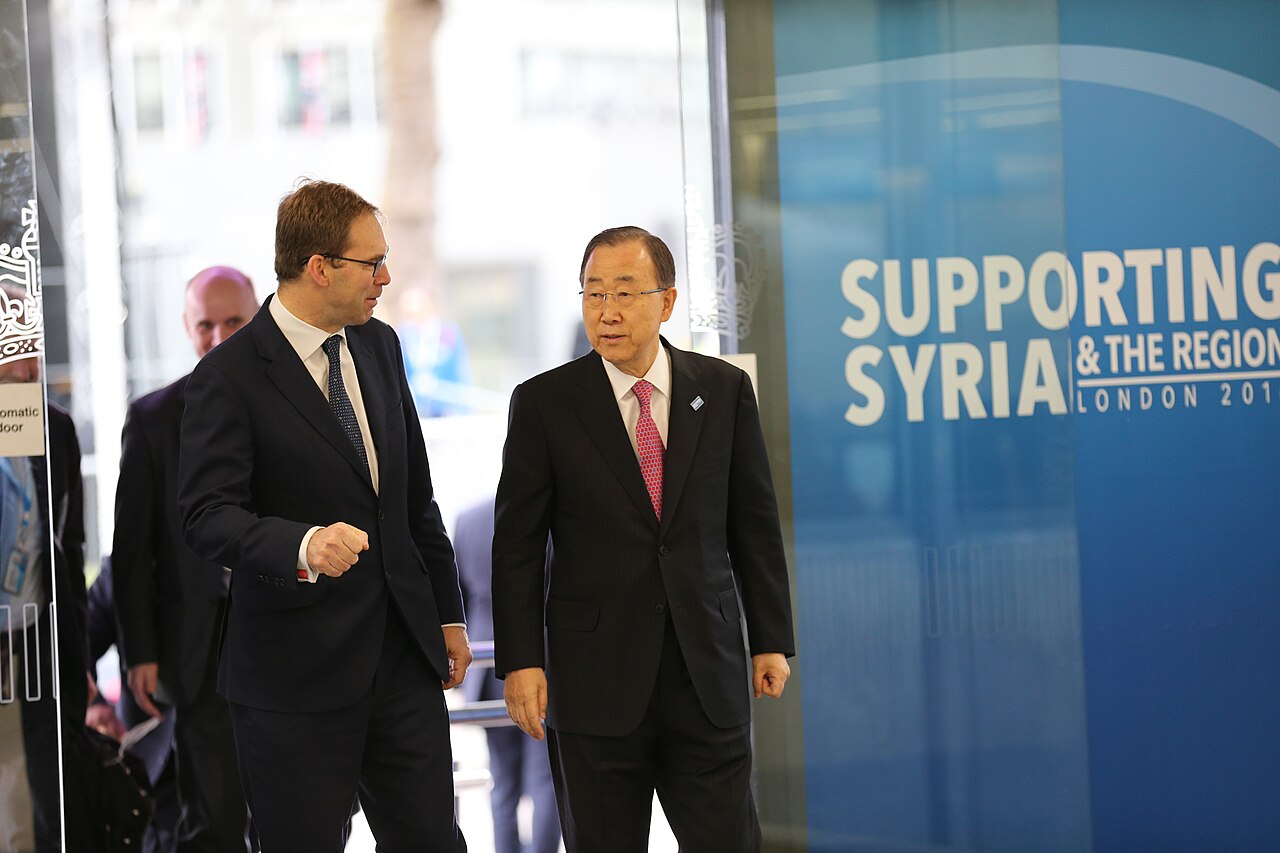
DFID - UK Department for International Development · CC BY 2.0
The United Nations Secretary-General (UNSG or UNSECGEN) serves as the organization's de facto leader, heading the UN Secretariat—one of its six main organs—and representing all 193 member nations globally. While the Security Council's president runs its meetings, the secretary-general acts as the UN's chief administrative officer, ensuring its decisions and mandates are carried out. This role is defined by Chapter XV (Articles 97–101) of the UN Charter, but its qualifications, selection process, and term length are not formally fixed; they have instead been shaped by custom.
The secretary-general is appointed by the General Assembly based on a Security Council recommendation. Since any of the five permanent council members can veto a nomination, most appointees have been compromise candidates from middle powers with little prior fame. Precedent has set unofficial rules: the appointee cannot be a citizen of a permanent Security Council member. A 1997 General Assembly resolution (51/241) called for regional rotation and gender equality in selecting "the best candidate," though no woman has ever held the post. Secretaries-general have come from varied backgrounds—Trygve Lie, for instance, was a politician and lawyer, not a career diplomat.
Terms are discretionary, but since 1971 every appointee has served five-year terms. With one exception—Boutros Boutros-Ghali, vetoed by the United States in 1996—every secretary-general since 1961 has been re-selected for a second term. No incumbent has sought a third term since 1981, when China cast multiple vetoes against various candidates during a deadlock, not solely against Kurt Waldheim. The selection process is opaque, often compared to a papal conclave. Since 1981, the Security Council has held secret straw polls, then submitted the winner to the General Assembly for ratification. Candidates have been rejected by the Assembly—for example, in 1950 when Trygve Lie's recommendation was turned down, and in 1953 when no candidate was elected. In 2016, the General Assembly and Security Council held public debates and sought nominations for the first time, but the council still voted privately, prompting the Assembly president to criticize the process for failing to meet expectations of transparency.
The UN Charter designates the secretary-general as the "chief administrative officer," with authority to hire Secretariat
- Role
- De facto head of the United Nations
- Appointed by
- General Assembly upon recommendation of Security Council
- Term length
- Discretionary; all since 1971 have been five-year terms
- Qualifications
- Not a citizen of any permanent Security Council member; varied backgrounds by precedent
- Residence
- Townhouse at 3 Sutton Place, Manhattan, New York City
- Key power
- Can inform Security Council of any matter threatening international peace and security
Lore & Background
The secretary-general is appointed by the General Assembly upon the recommendation of the Security Council, where any of the five permanent members can veto a nomination. Most secretaries-general are compromise candidates from middle powers with little prior fame. Unofficial qualifications include not being a citizen of any permanent Security Council member, and since 1997, due regard has been given to regional rotation and gender equality, though no woman has yet served. Appointees have had varied backgrounds—for example, Trygve Lie was a politician and lawyer, not a career diplomat. The selection process is opaque, often compared to a
Reader's Guide
The secretary-general serves as the United Nations' chief administrative officer, overseeing the Secretariat and implementing Security Council decisions. The office combines functions of advocate, diplomat, civil servant, and CEO. The secretary-general's powers include informing the Security Council of threats to peace and performing functions entrusted by other UN organs. Many powers are informal, allowing some appointees to be activist (e.g., Dag Hammarskjöld's armistice promotion, Javier Perez de Cuellar's Iran-Iraq ceasefire negotiation, U Thant's role in the Cuban Missile Crisis) while others are more technocratic. The secretary-general also chairs the United Nations System Chief Executives Board for Coordination. The role is often described as the world's most visible bully pulpit or the world's moderator. The official residence is a townhouse in Manhattan donated in 1972.
Did You Know?
- No woman has yet served as secretary-general, despite a 1997 General Assembly resolution calling for due regard to gender equality.
- Every secretary-general since 1961 has been re-selected for a second term except Boutros Boutros-Ghali, vetoed by the United States in 1996.
- In 1981, China cast a record 16 vetoes against a third term for Kurt Waldheim, after which incumbents avoided seeking a third term.
- The selection process has been compared to a papal conclave, with secret straw polls in the Security Council since 1981.
Origins & Legal Foundations
UN peacekeeping holds a peculiar place in international law because the United Nations Charter contains no reference to it whatsoever. The Charter's framers had designed a collective security system in which the Security Council would command armed forces made available by member states under Article 43, coordinated through a Military Staff Committee created by Article 47. That architecture never functioned as intended, because disagreements between the two Cold War blocs rendered the original mechanisms inoperable. Peacekeeping therefore arose as an improvised institutional response to crises the Security Council still wanted to address despite the failure of its planned tools. Secretary-General Dag Hammarskjöld memorably labeled the practice "Chapter Six and a Half," a phrase capturing its legal limbo between the peaceful dispute-settlement provisions of Chapter VI and the coercive military measures of Chapter VII. That shorthand has persisted as the standard description of peacekeeping's operational and legal position, a reminder that the practice grew out of necessity rather than design.
Core Principles & Operational Framework
Three interdependent principles govern every UN peacekeeping deployment, first articulated by Dag Hammarskjöld in 1958 and later codified in the 2008 document known as the Capstone Doctrine. The first requires the consent of the parties to a conflict, who must be committed to a political process; without that consent, an operation risks becoming a belligerent itself. The second demands impartiality, meaning peacekeepers implement their mandate without favoring any side. Crucially, impartiality is not the same as neutrality: a mission may penalize violations of a peace process while remaining even-handed in its overall conduct. The third principle restricts the use of force to self-defense and defense of the mandate, though the concept of "robust peacekeeping" permits proactive deterrence of attempts to disrupt the mission. These principles have been stretched considerably by post-Cold War demands, particularly the third. Yet even when the Security Council authorizes robust Chapter VII mandates, it routinely reaffirms all three principles in the operative paragraphs of its resolutions, underscoring their continuing centrality to the practice.
Evolution & Distinction from Related Activities
UN peacekeeping is frequently confused with three related but distinct activities. Peacemaking involves diplomatic efforts—mediation, arbitration, negotiation—aimed at bringing hostile parties to a negotiated settlement, typically under Chapter VI of the Charter. Peace enforcement, by contrast, employs coercive measures including military force to restore peace under Chapter VII; it does not require the consent of the parties and is usually carried out by member-state coalitions or regional organizations rather than by UN-commanded forces. Peacebuilding addresses the longer-term structural causes of conflict, supporting institutional development and economic recovery to consolidate a fragile peace. In practice, these activities overlap heavily, and contemporary peacekeeping operations routinely incorporate elements of all three. Scholars commonly trace the evolution of peacekeeping through three broad generations: traditional observer missions, multidimensional operations supporting complex peace agreements, and robust deployments that may protect civilians in active conflicts. The mandates have expanded dramatically from the small, unarmed observer groups of the 1940s and 1950s to the large, multifaceted operations of today, though the periods overlap and the categories are not formal UN classifications.
Scale, Impact & Legacy
The sheer scale of UN peacekeeping is difficult to overstate. Since 1948, more than two million individuals from 125 countries have served across 72 distinct operations. The collective effort earned the Nobel Peace Prize in 1988, a recognition of the cumulative contribution of soldiers, police officers, and civilian personnel who wear their home nations' uniforms alongside the iconic Blue Helmets or Blue Berets that have become synonymous with the practice. As of 2026, eleven operations remain active, drawing roughly 53,000 personnel from 117 contributing countries under a combined budget of $5.66 billion. The largest troop contributors include Nepal, Rwanda, Bangladesh, India, and Pakistan. Research by scholars indicates that peacekeeping is associated with reduced conflict recurrence and fewer civilian casualties, though effectiveness varies depending on local conditions and the specific mandate of each mission. The Department of Peace Operations, headed since April 2017 by Jean-Pierre Lacroix, administers these operations on behalf of the Security Council, which retains ultimate authority over their authorization.
Gallery
Frequently Asked Questions
Who is the Secretary-General of the United Nations?
The Secretary-General is the de facto head of the United Nations and serves as the chief administrative officer of the entire organization. The position is defined in Chapter XV of the UN Charter, and the current officeholder is appointed by the General Assembly based on a recommendation from the Security Council.
What powers and responsibilities does the UN Secretary-General hold?
The Secretary-General heads the UN Secretariat, one of the six principal organs, and is responsible for ensuring that the decisions and mandates adopted by the organization are actually implemented. A uniquely powerful authority is the ability to bring any matter that threatens international peace and security to the attention of the Security Council at any time.
How is the UN Secretary-General selected and how long do they serve?
The General Assembly appoints the Secretary-General following a recommendation from the Security Council, though the Charter does not prescribe a fixed term length. In practice, every officeholder since 1971 has been granted a five-year term, a convention that has solidified through precedent rather than formal rule.
What qualifications are required to become UN Secretary-General?
The only explicit restriction is that the candidate must not be a citizen of any of the five permanent Security Council members. Beyond that, there is no fixed list of credentials; instead, selection has been shaped by diplomatic custom, and past holders have come from a wide variety of national and professional backgrounds.
Why is the Secretary-General role considered important in international diplomacy?
As the single individual who represents all 193 member states on the global stage, the Secretary-General functions as the UN's public face and chief executive, bridging the gap between political decisions and their practical execution. The role carries enormous moral and diplomatic weight precisely because it sits above any single nation's interests while still being accountable to the collective membership.
More in International Law & Diplomacy 1-24
Spotted an error? Know more?
This is a living reference — every entry is fact-audited, and reader corrections feed straight into our audit queue. Suggest an edit · See this site's audit record